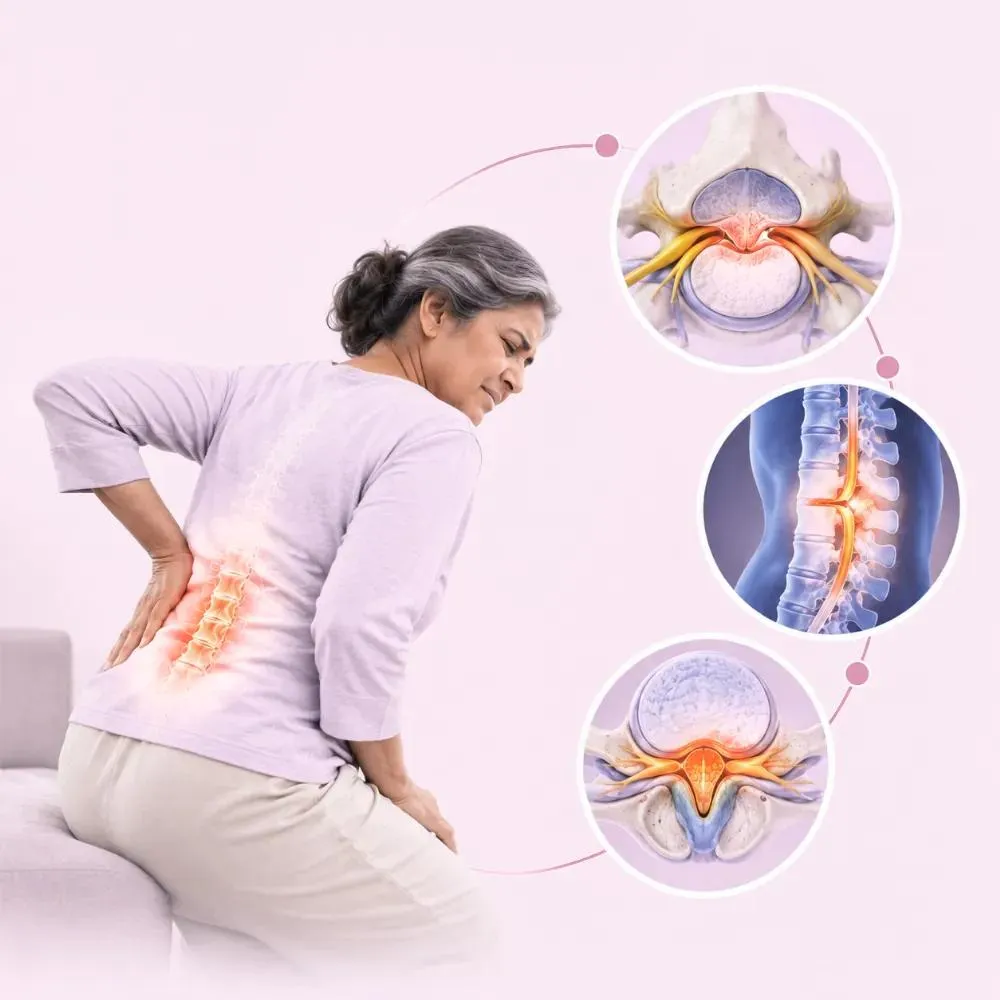
Yoga has earned a well-deserved reputation as a tool for managing back pain. Multiple systematic reviews have found consistent evidence that regular yoga practice reduces chronic low back pain and improves functional ability in affected populations. As a result, doctors increasingly recommend it, physiotherapists integrate it into rehabilitation programmes, and millions of Indians practise it with the specific goal of managing their backs.
What is discussed far less often is that yoga — when the wrong poses are chosen for the wrong spinal condition — can also worsen disc herniation, aggravate sciatic nerve compression, and provoke flares in conditions like spondylosis and stenosis. The difference between yoga that helps and yoga that hurts lies almost entirely in diagnosis and informed selection.
Why Yoga Helps Back Pain — The Mechanisms
At its most fundamental level, yoga addresses back pain through three overlapping mechanisms. First, it builds strength in the muscles that support the spine — particularly the deep stabilisers (multifidus, transverse abdominis) that maintain vertebral alignment and reduce load on passive structures. Second, it improves flexibility in the hip flexors, hamstrings, and thoracic spine — tight structures that, when restricted, force the lumbar spine to compensate and absorb forces it was not designed to manage alone. Third, it activates the parasympathetic nervous system, reducing cortisol-driven inflammation and lowering the central nervous system’s pain sensitisation.
All three mechanisms are real and clinically meaningful. The challenge is that the poses that deliver these benefits vary considerably depending on what is actually happening in the spine.
Poses That Help Most Spinal Conditions
Child’s Pose (Balasana)
One of the most universally safe and beneficial positions for the lumbar spine, child’s pose gently elongates the lower back, opens the sacroiliac joints, and allows the paraspinal muscles to fully release tension. It is particularly helpful for facet joint compression pain and general lumbar stiffness, and is safe for most people including those with mild disc bulges.
Cat-Cow (Marjaryasana-Bitilasana)
The gentle cyclical flexion and extension of cat-cow drives fluid exchange through spinal discs, maintains facet joint mobility, and re-educates the proprioceptive sense of spinal neutral position. Done slowly and within a pain-free range, it is one of the most therapeutic movement sequences available for chronic low back pain.
Supine Knee-to-Chest (Apanasana)
Drawing one or both knees to the chest gently stretches the lumbar erector spinae, decompresses the lumbar facet joints, and provides traction on the sacroiliac joint. It is effective for morning stiffness and is particularly helpful for those whose lumbar pain is worse in extension (a common pattern in facet-dominant pain and spondylolisthesis).
Poses That Commonly Worsen Spinal Conditions
Forward Folds With a Rounded Spine
Standing or seated forward folds performed with a rounded lower back (which the majority of people with tight hamstrings will produce) place the lumbar discs in a flexed and loaded position — exactly the loading pattern most likely to worsen a posterior disc herniation and compress an adjacent nerve root. If you have been diagnosed with a disc bulge or herniation, any forward fold should be performed with a hip hinge that maintains lumbar lordosis, not a rounded-back reach for the floor.
Seated Spinal Twists
Deep spinal rotation under load — particularly twists performed while seated with one leg extended and the torso rotating forcefully — generates shear forces at the disc-vertebra interface. For individuals with disc pathology, this can precipitate or worsen a herniation. Gentle supported twists performed supine are generally safe; aggressive seated twists are not.
Upward Dog and Deep Backbends
Full spinal extension poses like upward dog (Urdhva Mukha Svanasana) or wheel pose significantly compress the posterior spinal structures — facet joints, pars interarticularis, and the posterior disc. For anyone with facet arthropathy, spondylolisthesis, or spinal canal stenosis, these poses can provoke significant pain flares. A cobra pose performed with the elbows bent and the lumbar spine only gently extended is a substantially safer alternative.
The Most Important Rule: Diagnosis First
The most dangerous yoga recommendation is a generic ‘yoga is good for your back’ without reference to what is specifically happening in that person’s spine. A programme suitable for someone with muscular low back pain can be actively harmful for someone with a grade 2 disc herniation. If you have ongoing back pain and want to use yoga as part of your recovery, start with a clinical assessment from a spinal specialist — such as the team at ANSSI Wellness — who can confirm your diagnosis and advise specifically on which movements are beneficial and which should be avoided for your particular condition.
Conclusion
Yoga is a powerful tool for spinal health when it is prescribed intelligently. The right poses, practised with correct technique and appropriate modifications, can meaningfully reduce back pain, improve functional mobility, and support the structural changes that clinical treatment initiates. The wrong poses, prescribed without regard for the specific diagnosis, can undo clinical progress and worsen structural problems. Know your diagnosis. Choose your poses accordingly. And when in doubt, ask a clinician before you ask a yoga instructor.